

Entropy is invincible
An optimistic message for the new year (and beyond)

The dawn of modern science (as opposed to the ancient one) was marked by the idea of a clockwork universe. Kepler, Galileo, Descartes and particularly Laplace contributed to this idea, but Newton was an exception: He was aware of the fragility of the universe. Almost 150 years ago, Boltzmann overturned this idea by showing that entropy is not a deterministic concept, but the quantification of uncertainty. He was followed by many other physicists (Heisenberg, Bohr), mathematicians (Poincare, Gödel) and philosophers (Popper) who understood that uncertainty rules this world, thus bringing back science and philosophy to its roots intuited by ancients: Heraclitus, Aristotle and Epicurus.
Heraclitus said it clearly (even though Einstein did not appreciate it):
Αἰών παῖς ἐστι παίζων πεσσεύων. Παιδός ἡ βασιληίη. (Time is a child playing, throwing dice. The ruling power is a child’s).
And Aristotle shaped the concept of the dipole potentiality vs. actuality
(δύναμις / potentia vs. ἐνέργεια / actualitas). Heisenberg1 understood the importance of the dipole:
The most important of these [features of the interpretation by Bohr et al.] was the introduction of the probability as a new kind of “objective” physical reality, the “potentia” of the ancients such as Aristotle; it is, to a certain extent, a transformation of the old “potentia” concept from a qualitative to a quantitative idea.
And he was followed by Popper:2
Both classical physics and quantum physics are indeterministic.
At the time the determinism was being abolished in physics, Marxists and supporters of historical materialism (or historical determinism) were reviving it in history, talking about a necessity that would inevitably drive the social transformation they envisaged.
But the real world history trashed also this deterministic idea. Unfortunately, however, trashed ideas may remain popular for centuries. And this happens both in science, where determinism continues to be the dominant paradigm, and in history. In particular, entropy, which is “our friend” and a purely stochastic concept, is regarded by the majority as “our enemy” and a deterministic concept.
I have written about it in an earlier post:

This post was about our new paper, which was then under review. Now it has been approved and published.3 (It appeared yesterday in an early access version that will be finalized soon):

Here is a quotation from the Discussion and Conclusions section of the final paper:
Entropy carries a bad reputation in both scientific and public discourse […], but this can be attributed to the fact that its meaning is greatly misunderstood because it is a stochastic concept, while the education system is based on the deterministic paradigm. Far from signifying decay, decadence, or disorder as usually thought, entropy is a formal quantification of uncertainty, the dominant feature in complex real-world systems. The tendency of entropy to increase and the related principle of maximum entropy formally describe the natural tendency of complex systems to move from less probable to more probable states. High entropy corresponds to a greater multiplicity of states, hence expanded freedom of choice, more opportunities, and structural resilience.
Being a non-conservation law, entropy maximization is also a driver of change. This is also the case in economics and we have shown that, starting from a bounded distribution that has low entropy, the inevitable tendency of entropy to grow would push the technological limits to high values—a pattern historically confirmed. Technological progress as well as growth of wealth are not merely compatible with entropy increase, they are its direct expression.
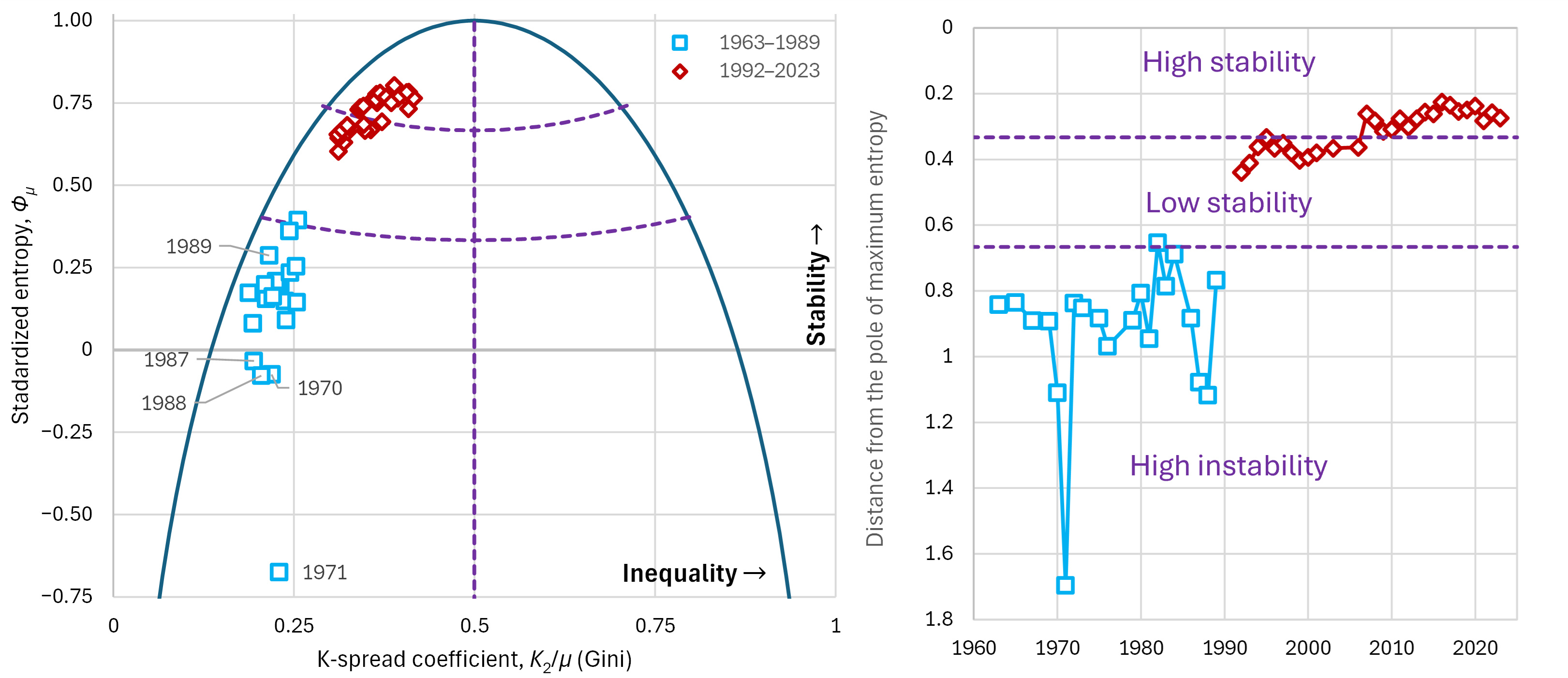
Entropy is closely tightened to freedom. Forcing entropy to decrease, or trying to create by force what is thought of as “order” is destined to fail, because low entropy means low stability or high instability. The following graph, presenting the evolution of entropy in Bulgaria from the period it was a Soviet satellite to the post-Soviet era, clearly shows the high instability (low entropy) in the former period and the stability (higher entropy) in the latter.
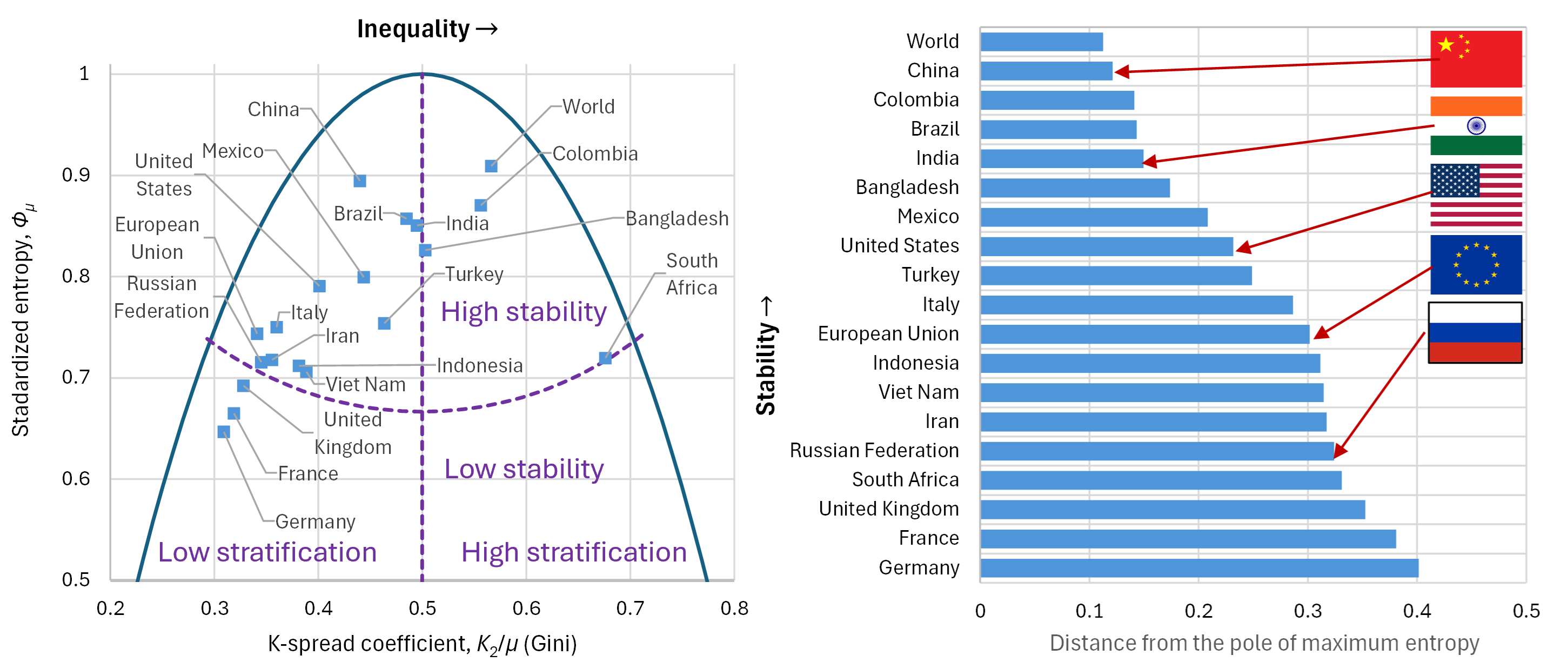
The following graph shows that today major countries (with populations > 50 million) lie in the area of high stability—with China being the champion and with the exception of United Kingdom, France and Germany, which in my view is not a surprise.
So, what is the optimistic message that I promised in the subtitle of this post? Well, arrangements imposed by force are doomed to fail. Such arrangements are not planned by Soviets anymore, of course. Controligarchs have replaced them—and without serving humanitarian and ethical values. Along with their uneducated minions, they are striking to deprive us of our freedom at a global scale. For example, Ursula von der Leyen has compared free speech (calling it “information manipulation”) to a virus and censorship to its vaccine (which provably she loves for several reasons).4 And I could cite much more examples.
Also, climafiosi and climinions pretend to predict the future climate conditions in years 2100, 3000, or 100 000 AD. They do that in order to threaten us so that we accept controligarchs’ plans. They invoke the future of their children, grand children, etc. —as if we don’t have ones and if we don’t care about others’ kids.
They will all fail. Entropy will win.
PS. The acknowledgments section of the paper contains the following dedication:
Dedicated to the memory of Katerina Souliou-Patrikiou and Ioanna Koutsoyianni-Christofaki (daughter in law and sister of DK, respectively), who left this world while this research was conducted.
Heisenberg, W., 1962. The development of the interpretation of the quantum theory. In Niels Bohr and the Development of Physics, Essays Dedicated to Niels Bohr on the Occasion of his Seventieth Birthday, edited by W. Pauli, 2nd edition, Pergamon Press, New York, 12-29, https://archive.org/details/nielsbohrdevelop0000paul/.
Popper, K., 1982. Quantum Physics and the Schism in Physics. Unwin Hyman, London, 229 pp.
Koutsoyiannis, D., and Sargentis, G.-F., 2026. Trade-off between entropy and Gini Index in income distribution. Entropy, 28(1), 35. https://doi.org/10.3390/e28010035
What she said (at about 14:00) is this: “Perhaps, if you think of information manipulation as a virus – instead of treating an infection, once it has taken hold, that is debunking – it is much better to vaccinate so that the body is inoculated. Prebunking is the same approach. Because disinformation relies on people passing it on to others”
Ursula von der Leyen is an evil person IMO
Thank you for expanding our understanding of entropy in the social sciences. Be sure to tell everyone whennthe full paper is available.