

The ridiculous intellectual state of the West
A couple of examples illustrating the rapid and complete decline of the once-thriving Europe and USA

While we are ranting about “climate science”, which as discussed in other entries is not science, there are people doing real science, which presupposes real education and meritocracy.
My today’s post was prompted by some news from the day before: Harvard University Drops [from first] To Third Place In Global Ranking 2025.
The ranking referred to, CWTS Leiden Ranking 2025, is Dutch, not Chinese. One can verify from the link above that the Harvard University is #3, was #2 last year and #1 two years ago. Most importantly, one can see that eight universities among the top-ten are Chinese.
However, this picture is misleading, because it includes “All sciences”, many of which are completely ridiculous (related to sustainability cult, climate impacts, gender-inclusivity, blah, blah, blah, etc.).
To get a more objective picture, free of performances in such “sciences”, I propose to limit the ranking to “Physical sciences and engineering.” Then we see that 25 universities out of the top-25 in the ranking are Chinese.
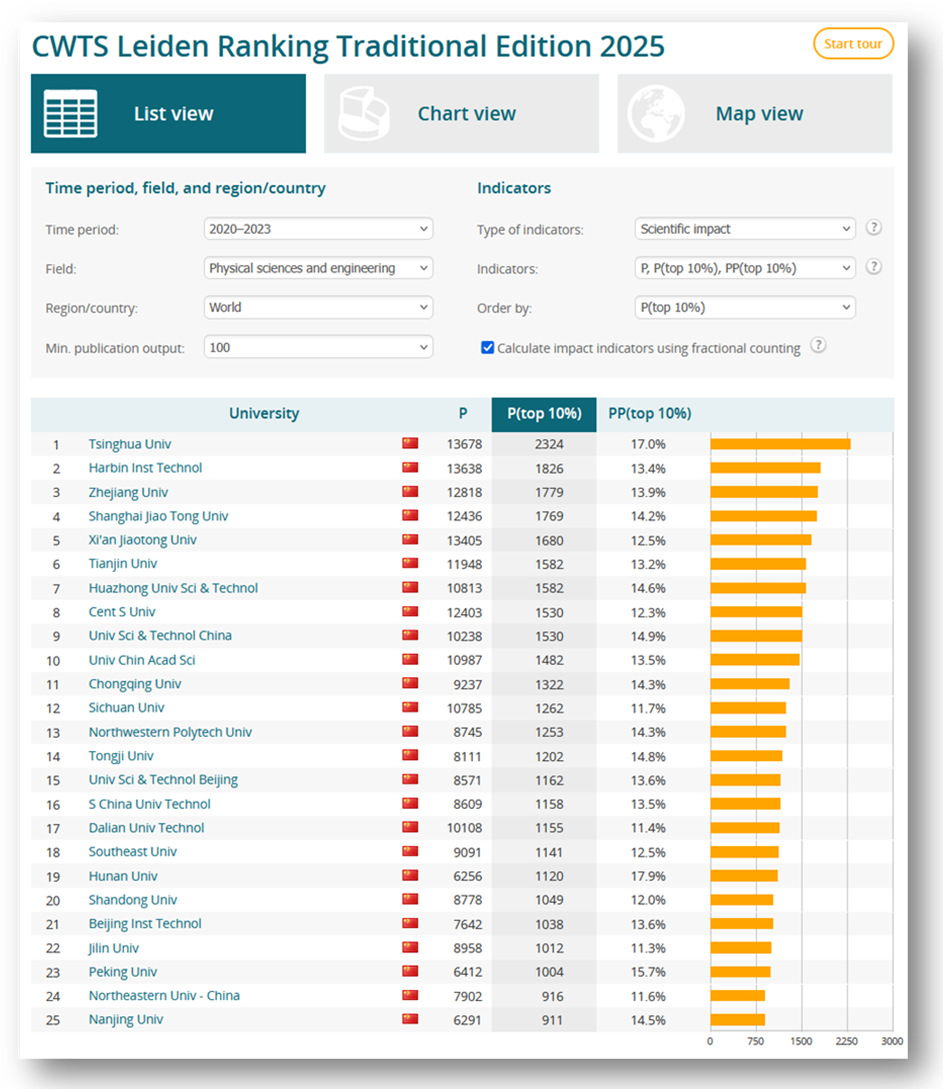
Twenty years ago, the picture was completely opposite, which shows that the Western decline was quite rapid:

The explanation is simple: the Chinese insist on meritocracy (and Confucius) at a time when the West as a whole has rejected it.
As a further indication of the decline, particularly in Europe, I am linking below two videos of Kaja Kallas, the Vice-President of the European Commission, and the EU leader for Foreign Affairs and Security Policy.
When I was a kid in the elementary school, if I didn’t know that Nazi Germany attacked the Soviet Union, and hence Russia, and that China and Russia were fighting fascism in the WWII, in alliance with the United Kingdom and the United States (and many more countries including Greece), the teacher wouldn’t let me pass to the next grade.
And now we, the 450 million of Europeans (the EU population), not only tolerate Kaja Kallas’ shocking lack of historical literacy, but we promoted her to the supreme position of leading foreign policy and shaping EU’s future. Of course, the problem started with her teachers, who gave her a primary school graduation certificate. It appears that she is associated with the WEF’s School of European Young Leaders. It would therefore be sensible for the WEF to test elementary school material before admitting students.
And in order not to be unfair to the EU president, Ursula von der Leyen, here is a video of her, showing her efforts to protect us from the existential threat of the free speech, which she calls “information manipulation”. She compares it to a virus and censorship to its vaccine (watch the video around 14:00).
I believe the most effective measures against decline are education and meritocracy. Freedom of expression, research and teaching is also a prerequisite—and in theory it is protected by “Article 13 - Freedom of the arts and sciences” of the EU Charter of Fundamental Rights. But with leadership such as in the above examples, and with rapidly declining schools and universities, I am afraid the situation in the West is no longer reversible.
DK - "I believe the most effective measures against decline are education and meritocracy. Freedom of expression, research and teaching is also a prerequisite..." I wholeheartedly agree with your post. If Randi Weingarten in Chicago USA is allowed to hold sway with respect to K - 12 education, we will not survive as a free people. If all actions in the West are aimed at boosting the "oppressed" regardless of merit, we will not survive as a free people. I have worked with Blacks, Latinos, and Asians in the US. Some demonstrated high merit, some did not, just like Whites. Some with little education showed high merit. Some with BA, MBA, and PhD's did not. It depends on the individual, and managerial ability to discern and reward merit leading to desirable results.
If the ranking you cite of universities worldwide in STEM fields holds for the future, we in the West will not survive as a free people. At 87, the rankings don't scare me, but for those who follow???
Dear Demetris, your are pointing out to one of the fundamental causes of the Western Civilization decline, which need to be immediately addressed along the lines of the Classical definitions of science, particularly those by Aristoteles. Here is a quick explanation of this decline and the recommended course of action.
GENERAL TITLE: THE CRISIS OF MODERN SCIENCE
The word "science" today has become a magical invocation rather than a descriptive term. "Science says so," "follow the science," "don't question the science" – these phrases constantly echo from politicians, journalists, and even from scientists themselves. But which science? According to what criteria? With what methodology? And most importantly: who decides what is science and what is not?
Aristotle would view the contemporary situation with concern. Because what is today called "science" often does not fulfill the basic criteria that he himself established for demonstrative science (ἐπιστήμη ἀποδεικτική). On the contrary, much of what is presented as "scientific findings" is in reality hypotheses, opinions, or even ideological constructs disguised in scientific language.
FROM SCIENCE TO SCIENTISM
The philosopher F.A. Hayek distinguished a crucial difference between science and scientism. Science is a humble method of inquiry, recognizing its limits, open to questioning, and progressing through the systematic overturning of erroneous theories. Scientism, on the contrary, is a dogmatic ideology that uses the prestige of science to impose political decisions, to silence dissenters, and to present as "indisputable" what is in reality contentious.
Contemporary society suffers not from excessive science, but from excessive scientism. And the difference is critical: science liberates the mind; scientism enslaves it.
THE VIOLATIONS OF THE SIX CRITERIA
Aristotle in the Posterior Analytics (71b 20-25) defined with mathematical precision that for a demonstration to be scientifically valid, the premises from which the conclusion is derived must be:
1. True – corresponding to reality
2. Primary – not requiring another proof (self-evident)
3. Immediate – with no disputed intermediate link
4. Better known – clearer than what is being sought
5. Prior – logically preceding the conclusion
6. Causes of the conclusion – explaining the "why"
Let us now examine how many of today's "scientific dogmas" fulfill these criteria.
Example A: Climate Change Models
The computational models that predict "catastrophic climate change" are presented as "settled science." But under the prism of Aristotelian criteria:
- True? Many models systematically overestimate temperature increase in relation to actual measurements
- Primary? They are based on hypotheses about feedbacks that themselves require proof
- Immediate? They include many intermediate links (clouds, oceans, aerosols) that are disputed
- Better known? The parameterizations are less clear than the predictions
- Prior? They are calibrated retrospectively (hindcasting) with historical data
- Causes? The causal relationship CO₂ → catastrophe is disputed by thousands of scientists
According to Aristotle, this is not yet demonstrative science, but hypothetical knowledge (opinion with reason). It may be useful, but it should not be presented as indisputable.
Example B: Pandemic "Scientific" Decisions
During the COVID-19 pandemic, many decisions were made under the pretext "we are following the science." But:
- Lockdowns: Was there empirical evidence about their effectiveness? (True?)
- Masks: The meta-analyses were ambiguous (Immediate?)
- School closures: Was the data for young people clearer than the decisions? (Better known?)
- Natural immunity vs. vaccines: Was the causal relationship fully explained? (Causes?)
Many of these "scientific" decisions were in reality political judgments disguised in scientific language.
THE CONFUSION OF SCIENCE AND OPINION
Aristotle distinguished clearly:
SCIENCE (demonstrative science):
- Deals with things that are "always the same" (ἀεί ὡσαύτως ἔχοντα = eternal beings) and things that occur "for the most part" (τα ὡς ἐπί το πολύ = statistically predominant)
- Concerns what "cannot be otherwise" (οὔκ ἐνδέχεται ἄλλως ἔχειν = cannot be different)
- Produces necessary conclusions from necessary premises
OPINION (δόξα, belief):
- Deals with things that are "accidental" (συμβεβηκός = random)
- Concerns what "can be otherwise" (ἐνδέχεται ἄλλως ἔχειν = can be different)
- Produces probable conclusions from hypotheses
Today's tragedy is that we confuse these two. Opinions – even highly probable opinions, even reasonably documented ones – are presented as scientific certainties. And whoever questions these opinions is accused of being "anti-scientific," when in reality they are simply insisting on Aristotelian criteria.
The tragedy of the western science is the fact that the vast majority of world scientists, ignore these definitions. The Aristotelian principle of "can be otherwise" (ἐνδέχεται ἄλλως ἔχειν), was repeated in the 20th century by Karl Popper in a much more narrower sense, as the principle of falsifiability, meaning that "a statement is falsifiable if it belongs to a language or logical structure capable of describing an empirical observation that contradicts it".
Of course with the "falsifiability principle" is not easy to negate the famous "anthropogenic climatic change" (ACC) as science, where as with the Aristotelian principle of "ἐνδέχεται ἄλλως ἔχειν), on the basis of research of famous scientists such as John Clauser, William Happer, Richard Lidsen and Demetris Koutsogiannis, is clearly negated as "δόξα".
THE "ARGUMENT" FROM MAJORRITY
One of the most catastrophic phenomena in contemporary "science" is the appeal to "consensus" – scientific agreement. "The overwhelming majority of scientists agree" becomes a substitute for proof.
But according to Aristotle – and according to all logic – this is a logical fallacy (argumentum ad populum). Truth is not subject to voting. Galileo was alone against the majority. Copernicus was alone. Socrates was alone. And they were right.
Moreover, the alleged "consensus" is often manufactured:
- Scientists who question are marginalized
- Research that questions is not funded
- Articles that question are not published
- Careers are destroyed
A self-fulfilling prophecy is created: "Everyone agrees" because those who don't agree are pushed out of the system.
THE POLITICIZATION OF SCIENCE
Aristotle would be deeply concerned about another phenomenon: the fusion of science and politics. When "science" becomes a weapon of political imposition, it ceases to be science and becomes ideology.
True science is politically neutral. Gravity doesn't care about our political party. The law of thermodynamics doesn't change according to our ideologies. But when "science" is used to impose:
- Drastic restrictions on freedoms
- Enormous economic changes
- Social transformations
...then we suspect that it is not about science but about politics.
THE TYRANNY OF "EXPERTS"
Another logical fallacy that Aristotle would reject is the argumentum ad verecundiam – the appeal to authority. "The experts say" is not proof. It is simply a transfer of responsibility.
Aristotle taught that arguments must be judged based on their logic, not based on the prestige of the speaker. A Nobel laureate can be wrong. A committee of experts can be swayed by economic incentives or political pressures. Truth has no titles – it has proofs.
THE FAILURE OF PREDICTIVE CAPABILITY
Aristotle would consider as a critical criterion of science the capacity for prediction. If our theories are true, they must produce accurate predictions. But:
- Climate models from the 1990s predicted much greater temperature increases
- Economic models failed to predict the 2008 crisis
- Pandemic models (Imperial College) predicted millions of deaths that did not materialize
When models systematically fail, scientific honesty demands revision. But instead of this, we often see a doubling down on dogmatism ("the models are correct, they just need improvement").
THE CORRUPTION OF PEER REVIEW
The institution of peer review was designed as a guardian of scientific integrity. But today it has often become a mechanism of censorship:
- Articles that question the dominant narrative are rejected not due to methodological errors, but due to "undesirable conclusions"
- Scientists take on as reviewers the articles of competitors
- Funding interests influence editorial decisions
Aristotle would ask: If "peer review" becomes an instrument of imposing orthodoxy instead of testing truth, how does it differ from religious censorship?
THE LOSS OF SCIENTIFIC HUMILITY
Perhaps the most serious of all: contemporary "science" has lost scientific humility. The phrase "the science is settled" is a heresy against the scientific method.
Aristotle taught that wisdom begins with the recognition of our ignorance. Socrates was wise because he knew that he knew nothing. But today, "scientists" tell us with absolute certainty what will happen in 50, 100, 200 years – when they cannot predict with accuracy what will happen next month.
This is not science. It is hubris.
THE ROAD TO RESTORATION
The crisis of modern science is epistemological, not technological. We don't need more data, more computers, more studies. We need a return to basic principles:
1. The six criteria of demonstrative science as a filter
2. Distinction between science - opinion - craft
3. Tolerance of questioning as a sign of health
4. Humility in the face of complexity
5. Freedom of research without political or economic constraints
Aristotle taught us that science is a method, not an authority. It is a process of seeking truth, not the possession of absolute certainties. And the only path to restoration of scientific credibility is a return to these basic principles.